Teachers
03 Jul 2026
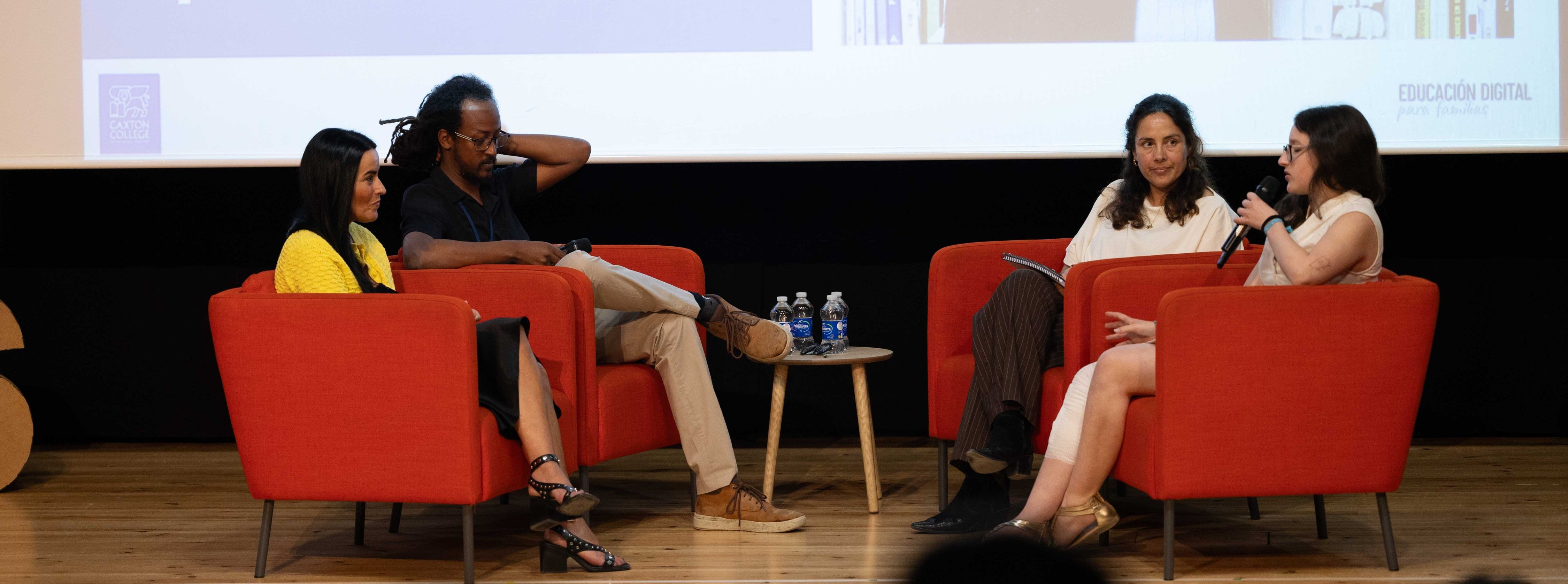
On Thursday, 21 May, Caxton College held its 9th Forum for Innovation in Education at school, with guest speaker Laura Cuesta Cano, Professor of Digital Communication and CEO of Educación Digital para Familias.
Laura spoke about the fact that many parents are anxious about how best to raise their children in the digital era, particularly at this moment when governments around the world are assessing the impact of social media on children under the age of 16 and taking proactive measures to limit children’s exposure to screens and platforms like TikTok.
Laura explained that whilst it may feel overwhelming, what is needed now more than ever is clarity. There should be a move away from hysteria and instead we need to understand that the digital world is just an extension of the ‘real’ world that we already exist in.
It is necessary to educate children (and ourselves) on what the digital world is and what platforms can and can’t do. Just like in the non-digital world, it is impossible to eliminate all the risks that children might encounter, so teaching online safety is important and, as adults, understanding what those risks are.
It is essential that parents are aware of what their children are doing online. A study of children’s social media use found that 78.3% of primary school aged children are active on social media, despite the age limit for many platforms being 13 years old. If those children are vulnerable, Laura cautioned, the way the platform functions can become a self-fulfilling prophecy. If a vulnerable child is searching for content about eating disorders on TikTok, for example, they will be served in their feed more and more of the same content reinforcing a certain perception within that child.
Laura also called out the popular platform Roblox. Whilst there are child accounts with restrictions, many children have standard accounts, which should be restricted to 16 years and above. Laura said that parents need to be aware how easy it is for predators and online groomers to access children on these sites and parents need to be sufficiently aware of what their children are doing online - just as you would be aware who your child is talking to and playing with offline. Parents should block the chat function and have sufficient parental controls to ensure their children are safe.
Regarding the use of technology in schools, Laura was clear that technology has a role to play in the classroom. It should be an additional tool at the disposal of the teacher when they are assessing how best to educate their class on a subject and when considering the question: what do I want to promote in my student’s learning? This does not mean that technology needs to be used in every lesson or even every day, but that there is a clear objective and strategic purpose to its use. Teaching children how to use technology appropriately will be increasingly important as the online world becomes more encompassing.
The role of parents in children's use of technology is fundamental. Laura advised that no child under the age of 14 needs to have a smart phone. Smart phones should not be given as a prize or present because then the child feels they ‘own’ the phone and it may be harder for the parent to enforce rules. Children can have access to non-smart phones and then parents should educate their children on how and when to use them. You wouldn't invite a stranger into your child’s room, but allowing them a smart phone with access to the full digital world on it is essentially doing the same.
Parents are the most important role-models to children. If at home a child sees that their adults are always on their phones or computers and haven’t set boundaries around their use, they will learn to do the same. Laura talked about setting up micro-habitats in the home where there might be a phone but also puzzles, books and games in order for children to see that other forms of entertainment are available.
Just as we teach children how to keep themselves safe in the real world, we must do the same with the online world. Children need to be educated to understand biases that they will encounter, to learn how to question information they see, to understand that their digital footprint can be permanent, and how to conduct themselves appropriately online.
To find our more about Laura’s work you can:
Read books by Laura Cuesta Cano here: https://www.profiteditorial.com/libro/crecer-con-pantallas/
Watch https://www.youtube.com/watch?v=Q1Uc8Bc8N7M
Related posts